

AI reduces SOC work only when the decisions it makes are governed and measured. Left ungoverned, it does not remove work, it moves work: from triage to review, from alert fatigue to AI-output fatigue, and from one queue to another with a different name.
A tool that auto-closes alerts has not reduced work if a human now has to check whether the auto-closures were right. A tool that summarises cases has not reduced work if the summary still needs verifying line by line. The queue did not shrink, it changed shape.
Why AI multiplies queues instead of shrinking them
Most SOC tools apply AI at the point of triage: score the alert, cluster the alert, draft a summary, suggest a verdict. Each of those is useful. None of them, on its own, removes a decision, it defers the decision one step downstream. Someone still has to check the score, confirm the cluster, or approve the verdict. If that checking step is not counted, the tool looks like it is working while the total decision load stays flat or grows.
The fix is not less automation, it is automation with a governed decision boundary. Without that boundary, AI output becomes a second queue sitting behind the first one.
What actually proves the work went down
Events processed, alerts raised and gigabytes ingested are supply-side numbers. They describe how much the system saw, not how much work it removed. Three measures describe the work itself:
| Measure | What it answers | What to look for |
|---|---|---|
| Queue compression | How many raw alerts turn into cases that need a human decision | The ratio of cases to alerts falling over time, not just alert volume falling |
| Human escalation rate | How many of those cases still need an analyst to act | A rate that holds steady or falls as ingest grows, not one held down by a fixed cap |
| Cost per resolved case | What it costs to close a case, not what it costs to license the tool | A trend across months, not a single snapshot pulled from a pilot |
Ask any vendor, including us, to show these three as trends over a real time window. A single good month proves a pilot went well. A trend proves the decision boundary is holding as volume rises.
One funnel, not the industry average
In a Fortune 500 environment, SenseOn's platform analyses 33.4B events a month. That funnel narrows to 36,000 alerts, then to 173 cases requiring human judgement across 30 days, which is roughly six human escalations a day. That is one customer's funnel, in one environment, over one measurement window. It shows what queue compression and escalation rate look like when they are tracked end to end; funnel shape depends on data volume, tuning maturity and the policy boundary a customer sets.
Across all customer environments, on a rolling 30-day window, 92.5% of cases raised are resolved without human escalation. SenseOn calls this the conservative aggregate: some environments, Fortune 500 deployments included, do better, others do worse, and the number moves as the denominator, total cases raised, moves with it. Quote a resolution rate only alongside the window and the population it was measured against, a rate with no denominator is not a measurement, it is a marketing line.
What governed actually requires
A governed decision boundary needs three things in place before the queue-compression number means anything. First, a defined scope: which actions the system may take without a human, and which it may not. Second, an evidence trail: every action, human or AI, recorded on an append-only record that can be produced for an auditor, not reconstructed from memory after the fact. Third, a live escalation path: cases the system cannot resolve inside its scope go to a human, and that hand-off is measured, not assumed. Remove any one of the three and the compression number stops being trustworthy, because there is no way to check it. The evidence trail is the one most often assumed rather than built; Provider Logs Can't Prove What Your AI Agent Did sets out why a provider's own logs do not meet it.
The honest gap: no cost-per-resolved-case figure exists yet
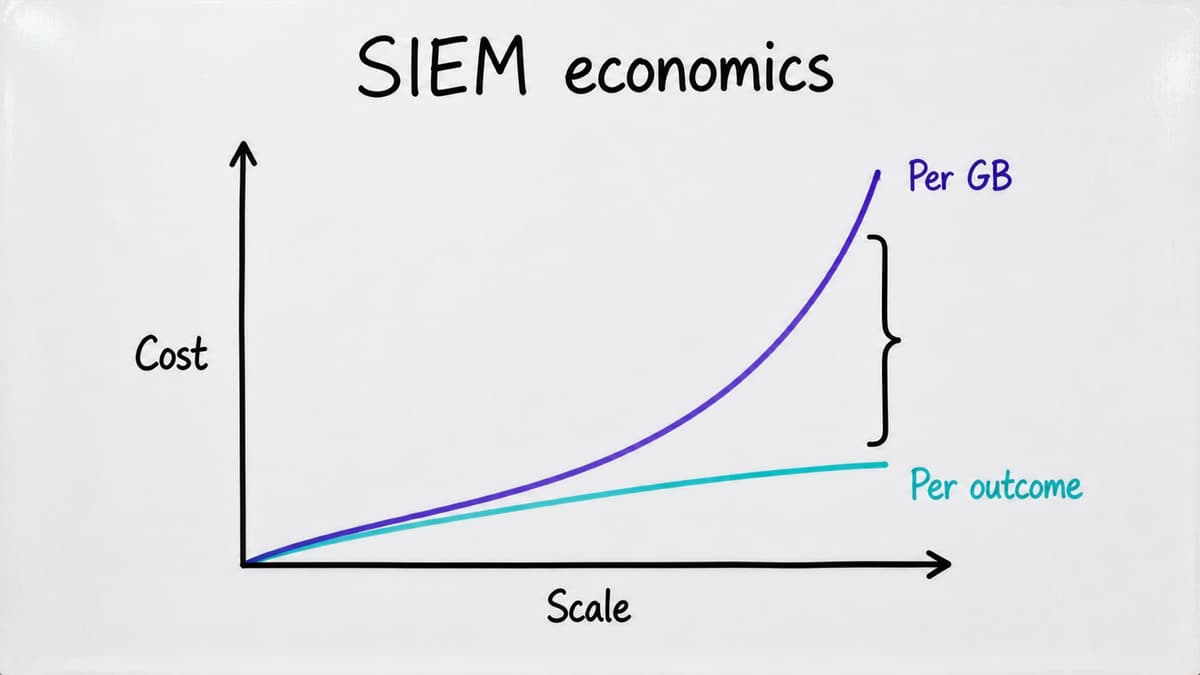
SenseOn does not publish a cost-per-resolved-case figure, and we are not aware of a credible published one from anyone else in the market either. Queue compression and escalation rate are measurable today from case data alone. Cost per resolved case needs cost data joined to case data, licensing, staff time, and infrastructure spend, mapped against outcomes, and most SOC tooling still bills and reports on volume, not on outcomes, so the join rarely gets made.
That gap is not a footnote, it is the buying question. If a vendor cannot show queue compression and escalation rate as trends, and cannot explain why cost per resolved case is not measured yet, you are being sold a bigger funnel, not less work. AI that is not governed and measured this way will keep moving work into a new queue with an AI label on it. AI that is governed and measured this way is the only version worth paying for.
None of this is a claim that AI replaces analysts or reduces headcount. It is a claim about where the work goes: into a measured, governed decision boundary, or into an unmeasured queue with a different name. The same test applies when AI does offensive work: Does AI pentesting work? asks whether a run repeats, how much validation it needs and whether findings reach remediation, which is the same question as whether the queue shrank.
Related reading:
- The CISO's AI Accountability Playbook
- Provider Logs Can't Prove What Your AI Agent Did
- Does AI pentesting work? What to measure before you buy
How SenseOn writes, checks and corrects its content: editorial standards.
