

An AI SOC is a security operations centre where AI agents do the investigative work (triaging alerts, gathering evidence, building timelines, proposing verdicts) while people keep the decisions that carry consequence. It is a way of running the SOC, not a product category. The useful question is not whether the AI is clever, but which decisions it may make and what record it leaves.
The term has been stretched. Vendors use "AI SOC" for a triage assistant, for a managed service with a language model attached, and for a platform that closes alerts on its own. Those are different risk positions. This guide sets out what an AI SOC does, how it differs from SOAR and from an autonomous SOC, how to evaluate one, and where it fails.
How does an AI SOC differ from SOAR and from an autonomous SOC?
Four models get sold under overlapping names. They differ on one axis: who holds the decision.
| SOAR | AI SOC analyst tools | Autonomous SOC | Governed AI SOC | |
|---|---|---|---|---|
| Who decides | The playbook author, in advance | The AI proposes, an analyst approves | The AI, at runtime, within a policy | The AI within a granted scope; a named person holds the case decision |
| What is automated | Fixed steps: enrich, ticket, block | Triage, evidence gathering, verdict drafting | Triage through to response and closure | Bounded work per job, with the human decision point declared for each |
| Evidence trail | Execution log of steps taken | Chat transcript or case summary | Varies; often a verdict without the reasoning path | A decision record: inputs, tools used, scope, output, who approved |
| Failure mode | Brittle: the playbook breaks when the environment changes | A second review queue: someone checks the AI's work | Silent wrong closure, found late or never | Over-escalation: a tight boundary leaves people carrying more cases than needed |
SOAR automates a known sequence. It scales steps you already wrote down; it cannot reason about the ones you did not.
AI SOC analyst tools reason, but the decision usually returns to a person. That is the honest design, and it does mean the work moves rather than disappears: see will AI reduce SOC work or just create a new queue?.
"Autonomous SOC" describes the end state: the AI investigates and closes with nobody in the loop. Parts of that are real today for high-confidence, low-consequence cases. The whole of it is not, and any vendor claiming it end to end is describing a roadmap.
A governed AI SOC is the position SenseOn takes. Agents do bounded work inside a granted scope; each job names its human decision. Horus orchestrates, the specialists do the work, and AI for security sets out the job-by-job breakdown.
What does an AI SOC actually do?
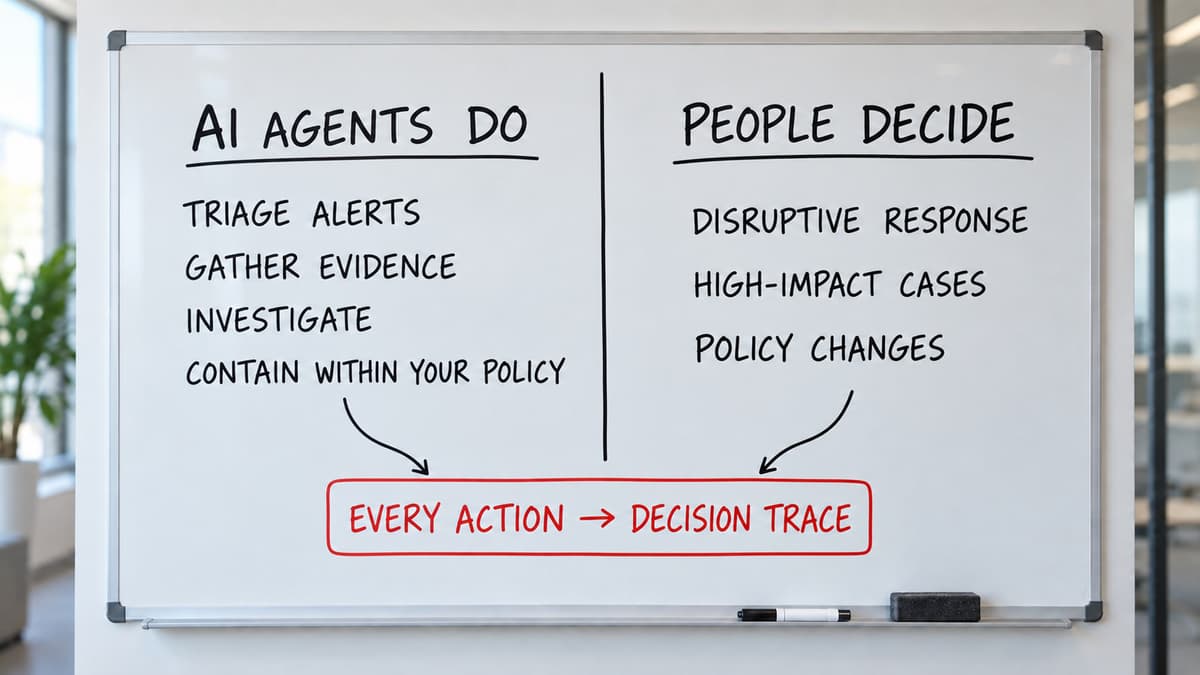
Who does what in a governed AI SOC: agents do the investigative work, people keep the consequential decisions, and both are recorded.
Five jobs, each with a decision that stays with a person.
Triage. The AI clusters, deduplicates and scores incoming alerts, and should say why an alert was dismissed, not only that it was. Human decision: set and review the suppression boundary, meaning what the AI may close without asking. Most alert fatigue survives AI triage because that boundary is never written down.
Investigation. The AI pulls telemetry across endpoint, network, identity and cloud, joins it into one entity timeline, and drafts a verdict with the evidence attached. This is where AI earns its place: the joining work is mechanical, slow and where human attention runs out. Human decision: close, escalate, or send it back.
Threat hunting. The AI turns a stated hypothesis into queries, runs them against retained data, and returns results with the query shown. Human decision: review the query before trusting the result. A hunt whose query you cannot read is a rumour; our threat hunting guide covers hypothesis design.
Detection engineering. The AI drafts, tests and tunes detection content against historical data, and flags rules that have stopped firing. Human decision: approve, amend or reject deployment. The CardinalOps 2025 State of SIEM Detection Risk report found enterprise SIEMs cover 21% of MITRE ATT&CK techniques, leaving 79% uncovered, and that around 13% of existing rules cannot fire at all. AI writing detections onto a broken floor produces confident coverage of nothing.
Posture. The AI ranks misconfigurations and exposures by likely impact rather than raw severity. Human decision: prioritise or accept the risk, with a name against it.
Not on the list: deciding risk appetite, accepting residual risk, telling a regulator what happened, or judging whether an insider's behaviour is malicious or miserable. Those are not automation gaps. They are the job.
What is an AI SOC analyst and how do you evaluate one?
An AI SOC analyst is software that performs an analyst's investigative workflow, taking an alert, gathering evidence, reasoning across it and reaching a verdict, rather than answering questions about it. A copilot waits to be asked; an AI SOC analyst works the queue. Five criteria separate one you can operate from one you can only demonstrate.
1. It shows its work. You should be able to read the path: what it queried, what it found, what it discarded and why. A verdict without a path cannot be reviewed, only believed.
2. It cites evidence, not summary. Every claim should link to the underlying event, with a timestamp and a source. Summaries of summaries are how a wrong conclusion becomes durable.
3. Its actions are reversible. Ask what it may do unattended, and how you undo each one. Isolating a host is reversible. Disabling a production service account at 03:00 is technically reversible and operationally a second incident.
4. Its true-positive rate is measured, with a denominator. Ask what fraction of investigated cases were confirmed true positives, over what window, across how many cases. SenseOn's figure is 0.68% confirmed true positives across 30M+ investigated cases on a rolling 12-month window. It is low because the denominator is honest: everything investigated, not everything escalated. A high true-positive rate usually measures the filter in front of it, not the detection.
5. Cost per investigation is known. Not licence cost, but cost per case worked, including model inference and the review time the AI creates. Almost nobody publishes this, us included. Ask anyway: the answer's shape tells you whether they measure it.
Two more figures to ask any vendor to match with their own methodology. SenseOn resolves 92.5% of incidents by AI under human governance on a rolling 30-day window, and analyses 33.4B events monthly in a named Fortune 500 environment, both published with their working on proof points. The point is not the number but its shape: a defined window, a defined population, a stated governance condition. A claim with none of those is a brochure.
Will AI replace the SOC?
No. It changes what the SOC does.
The 2025 ISC2 Cybersecurity Workforce Study, with 16,029 respondents, found 73% expect AI to create specialised cybersecurity roles rather than eliminate them, and that AI skills are the single largest skills gap, cited by 41%. The work does not vanish; it needs different hands.
Three things move. Tier-1 triage as a role largely disappears. Detection engineering grows, because AI systems need well-defined ground truth and someone has to build it. And a job appears that barely existed in 2023: governing the agents. Deciding scopes, reviewing decision records, testing whether the boundary holds as volume rises.
Three things do not move. Accountability stays with a named person; no regulator accepts "the model decided". Judgement about consequence, such as whether to pull a trading system offline during market hours, stays human. So does adversarial creativity, on both sides. The realistic gain is capacity and consistency, not payroll.
What are the risks of an AI SOC?
Hallucinated conclusions. A language model will produce a fluent, plausible, wrong incident narrative, and it reads exactly like a right one. The mitigation is structural: require every claim to carry an evidence link, so an unsupported assertion is visibly unsupported.
Silent failure. The serious one. A SOAR playbook that breaks throws an error. An AI that quietly starts closing a class of true positives produces a calmer dashboard and no error at all. You need a control that shares the filter, a scheduled human review of a sample of auto-closed cases, or the system will never tell you.
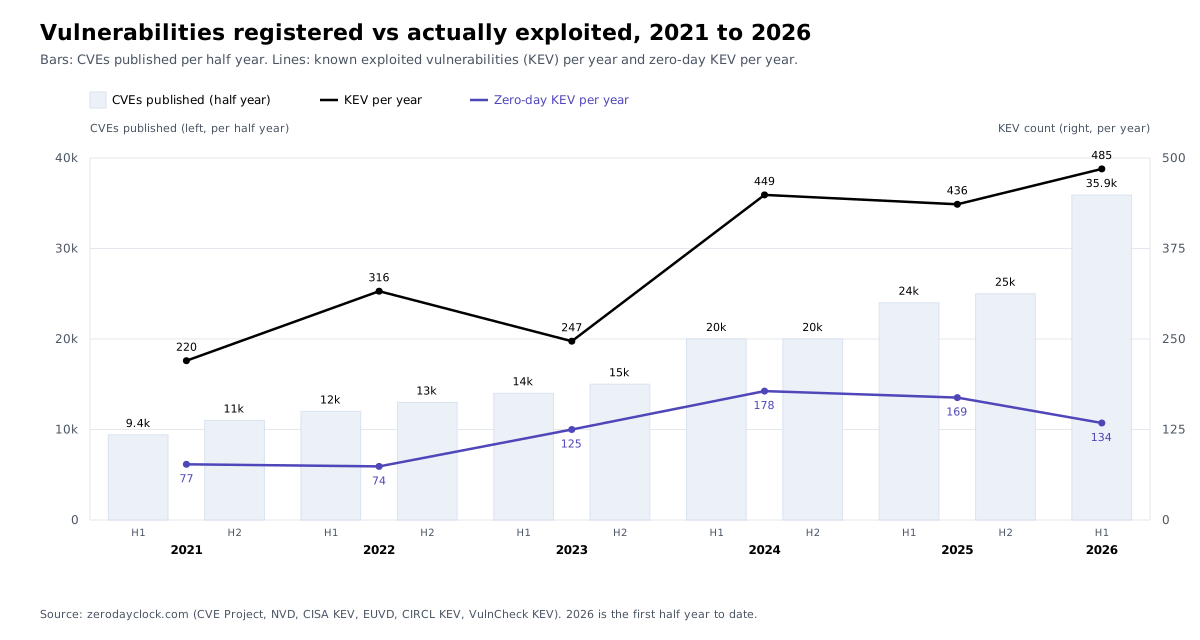
A balanced view of the queue: since 2021 the number of published vulnerabilities has roughly quadrupled, while the number actually exploited has roughly doubled and zero-day exploitation has flattened since 2024. The work that exploded is triage and prioritisation, not the count of real emergencies. An AI SOC earns its place by finding the small fraction that matters and showing why, not by processing the queue faster.
Prompt injection through telemetry. AI SOC agents read attacker-controlled text: filenames, user agents, email bodies, commit messages, DNS queries. OWASP ranks prompt injection as LLM01 in its Top 10 for LLM Applications, including indirect injection through content the model ingests rather than text a user types. Anyone who can get a string into your logs can try to instruct your investigator. Ask how a vendor's agents are isolated from instructions embedded in the data they analyse.
Vendor lock-in. AI SOC platforms want all your telemetry in their store, because reasoning quality depends on data breadth. That is a real technical argument and also a commercial one. Ask what leaves with you: raw data, normalised data, detection content, decision records. The last is the one people forget until an audit.
Audit gaps. If you cannot reconstruct six months later why a case was closed, you have an AI SOC you cannot defend in an incident review. The NIST AI Risk Management Framework organises this under Govern, Map, Measure and Manage, and Govern comes first for a reason. Treat decision-record retention as a requirement with a stated coverage figure, not a logging feature.
Which AI SOC tools and platforms exist in 2026?
A neutral list, in no order. Each line reflects the vendor's own public positioning as of September 2026, not our assessment of it.
- Palo Alto Networks Cortex XSIAM: an AI-driven SOC platform built on unified data, positioned by Palo Alto as "the autonomous SOC".
- Microsoft Security Copilot: a generative-AI assistive layer across Microsoft Defender XDR, Microsoft Sentinel and Entra, extensible with plugins.
- SentinelOne Purple AI: an agentic AI security analyst that collects evidence, correlates telemetry and builds attack timelines inside the Singularity platform.
- CrowdStrike Charlotte AI: an agentic AI security analyst built natively on the Falcon platform, coordinating agents across domains.
- Dropzone AI: an agentic SOC for autonomous alert investigation, threat hunting and threat-intelligence analysis, marketed on showing the AI's reasoning.
- Torq: an AI SOC platform combining hyperautomation with agentic Auto Triage that deduplicates events and filters false positives.
- Prophet Security: a set of AI agents that investigate every alert, hunt threats detections miss, and optimise detection coverage.
- Exaforce: an agentic SOC platform and MDR service built on a unified data layer and real-time knowledge graph.
- Swimlane: Turbine, a low-code security automation platform extending from playbooks to agentic triage and autonomous investigation.
- Intezer: an AI SOC that triages, investigates and responds to alerts, positioned as closing gaps left by MDR services.
- SenseOn: a unified detection platform with governed agents. Horus orchestrates, and Weave, Forge, Resolve, Hunter and Insight each do bounded work with a declared human decision.
Also worth knowing: Vectra AI and Darktrace come at the same problem from network detection, and Splunk, IBM QRadar and Google SecOps are the SIEM estates most of these platforms sit on or replace; our SIEM alternatives comparison scores seven of them.
"AI SOC" and "agentic SOC" are used interchangeably here, so compare architectures, not labels. Ask every vendor the same three questions: what does it close without asking, what evidence does it attach, how do I reverse it.
Related reading: what AI does in threat detection covers the detection layer underneath all this, and our SOC automation guide covers what to automate first. For the survey view, see the SANS 2025 SOC Survey; MITRE ATT&CK remains the benchmark to measure any of these platforms against.
Frequently asked questions
What is an AI SOC?
An AI SOC is a security operations centre where AI agents perform investigative work, triaging alerts, gathering evidence, building timelines and proposing verdicts, while people retain decisions that carry consequence. It is an operating model rather than a product category. The defining question is which decisions the AI may make unattended, and what evidence record it leaves behind for review.
Will SOC be replaced by AI?
No. AI removes most tier-1 triage work, but it does not remove accountability, judgement about consequence, or adversarial thinking. The 2025 ISC2 Cybersecurity Workforce Study found 73% of practitioners expect AI to create specialised security roles rather than eliminate them. Expect roles to shift towards detection engineering and governing the agents, not to disappear.
What is the difference between SOAR and an AI SOC?
SOAR executes a sequence a human wrote in advance; it scales known steps and breaks when the environment drifts. An AI SOC reasons over evidence it gathers at runtime and proposes a verdict, including for situations nobody scripted. SOAR's failure mode is brittleness. An AI SOC's failure mode is a confident, wrong conclusion, which is why evidence trails matter more.
What is an AI SOC analyst?
An AI SOC analyst is software that performs an analyst's investigative workflow end to end, takes an alert, gathers related telemetry, reasons across it and reaches a verdict, rather than answering questions on request. Evaluate one on five things: whether it shows its work, cites evidence, takes reversible actions, publishes a measured true-positive rate, and knows its cost per investigation.
What is an autonomous SOC?
An autonomous SOC is the end state in which AI investigates, decides and closes cases without a person in the loop. It exists today only for high-confidence, low-consequence alert classes. Anyone claiming it end to end is describing a roadmap. The practical version is a governed AI SOC: agents act inside a granted scope, with a named human holding the case decision.
Related: SOC as a Service: A UK Buyer's Guide (2026)
How SenseOn writes, checks and corrects its content: editorial standards.
